
BLOOM: The Act of Remembrance: SOLO SHOW BY DAGMAR VAN WEEGHEL

Curatorial Text by Hedy Van Erp
BLOOM is a four-year project by Dutch artist Dagmar van Weeghel, made in collaboration with women of African descent across Europe. It addresses a major gap in the 19th‑century European visual archive: between photography’s invention (c.1839) and 1900, images of people of colour – especially cartes de visite of women – are rare, anonymous, or absent. Legal timelines (e.g. Britain’s slave trade ban in 1807, emancipation in 1833; Dutch manumission in 1873) partly explain but do not justify that recorded histories privilege whiteness and erase plural lives.
Each BLOOM portrait is co‑authored: participants contribute life histories, reflections on migration, belonging, and visibility, and share in the project’s proceeds. Van Weeghel does not speak for them; her practice exposes the visual frameworks that constrained or erased their presence and creates space for fuller representation.
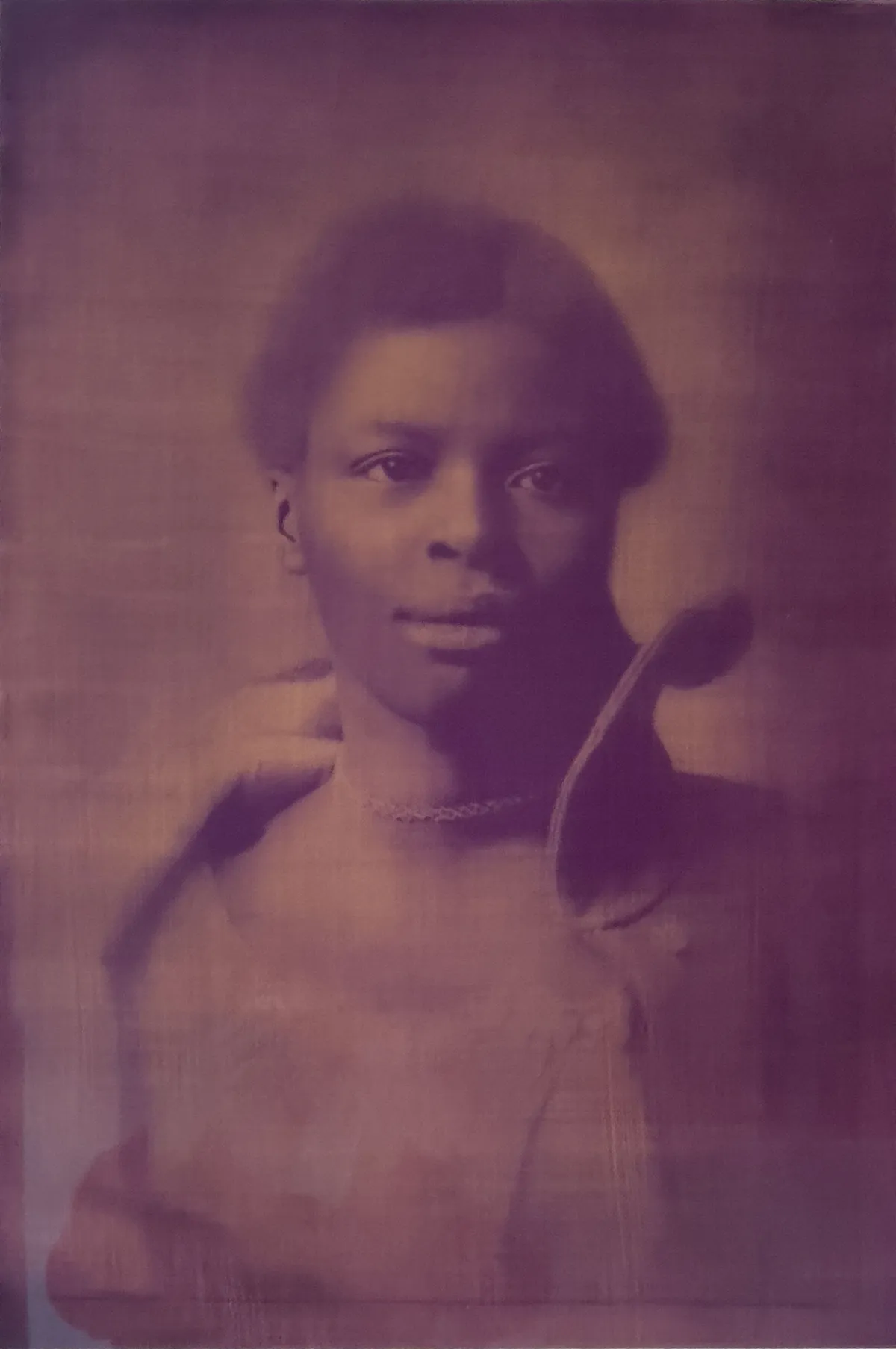
The work deliberately uses 19th‑century tools and techniques – an original 1868 carte de visite camera, hand‑colouring with self‑made floral pigments, and anthotypes (camera‑less prints made by exposing flower‑pigmented paper to sunlight) – to question photography’s claim to truth. Rather than nostalgic mimicry, these methods reveal photography’s constructedness and its historical bias about which lives merited preservation.
Botanical history functions as both metaphor and material. Inspired by an 1818 French manual later republished as The Victorian Language of Flowers – which catalogued roughly 300 floral meanings used socially in the 19th century – BLOOM engages floriography: a popular, often secret language that encoded feelings and social codes. Many floral meanings were bound up with gendered and racist Victorian pseudoscience.
Van Weeghel uses petals gathered across the Netherlands, France, Scotland, and England to make pigments. The anthotypes and floral pigments trace plant circulation through trade and empire, drawing parallels between botanical translocation and diasporic movement. This material linkage highlights how ideas about origins, usefulness, and invasiveness travel through natural and social systems. Platinum–palladium prints, which have the best longevity, were produced to ensure archival permanence.
Van Weeghel’s personal position – as a white European and mother of mixed‑heritage children – frames the project as an act of responsibility and proximity. BLOOM is not an attempt to rewrite the past but to widen the archival frame: an intervention that foregrounds co‑authorship, dignifies presence, and seeks long‑term visibility. By collapsing historical distance into contemporary reckoning, it treats photographic history as ongoing and calls for acknowledgment, accountability, and care for the images we pass on.
-
 DAGMAR VAN WEEGHELPENDA IN BLOOM - DO NOT REFUSE ME, 2022PhotoRag Archival Pigment Print with white border110,5 x 160 cmEdition of 3 plus 2 artist's proofs(Edition record)
 -
DAGMAR VAN WEEGHELLYS IN BLOOM - LET’S SPEAK IN FLOWERS, 2023PhotoRag Archival Pigment Print with white border121,5 x 120 cmEdition of 3 plus 2 artist's proofs(Edition record)
-
DAGMAR VAN WEEGHELEMMA & ANDREA IN BLOOM - THE BOTANY OF MEMORY I, 2023PhotoRag Archival Pigment Print with white border60 x 46 cmEdition of 5 plus 1 artist's proof(Edition record)
-
DAGMAR VAN WEEGHELDEDE IN BLOOM - A BOUQUET FOR ENDURANCE, 2022PhotoRag Archival Pigment Print with white border121,5 x 120 cmEdition of 3 plus 2 artist's proofs(Edition record)
-
DAGMAR VAN WEEGHELDEDE IN BLOOM - THE ACT OF REMEMBRANCE, 2022PhotoRag Print, Hand-tinted with Flower Pigments & Watercolors, with white border40 x 60 cmEdition of 3 plus 1 artist's proof(Edition record)
-
DAGMAR VAN WEEGHELBINQUI IN BLOOM - WHAT A THOUSAND PETALS HOLD, 2022PhotoRag Archival Pigment Print with white border43,5 x 60 cmEdition of 5 plus 1 artist's proof(Edition record)
-
DAGMAR VAN WEEGHELEMMA IN BLOOM - ACANTHUS FOR THE UNNAMED, 2022PhotoRag Archival Pigment Print with white border41,5 x 60 cmEdition of 5 plus 1 artist's proof(Edition record)
-
DAGMAR VAN WEEGHELEMMA & ANDREA IN BLOOM - THE BOTANY OF MEMORY II, 2023PhotoRag Archival Pigment Print with white border60 x 41 cmEdition of 5 plus 1 artist's proof(Edition record)
-
DAGMAR VAN WEEGHELFATOU IN BLOOM - UNFOLDING TOWARD THE LIGHT (In Her Spirit Edition), 2022PhotoRag Print, Handpainted with African Marigold, Coreopsis, Dahlia Chamomile, Walnut, Madder & Watercolor66 x 96 cmEdition of 5 plus 1 artist's proof(Edition record)
-
DAGMAR VAN WEEGHELIMMACULATE IN BLOOM - HERE IN MY GARDEN, 2022PhotoRag Archival Pigment Print with white border82,5 x 120 cmEdition of 5 plus 1 artist's proof(Edition record)
-
DAGMAR VAN WEEGHELMONICA IN BLOOM - A YELLOW ROSE, 2022PhotoRag Archival Pigment Print with white border43,5 x 60 cmEdition of 5 plus 1 artist's proof(Edition record)
-
DAGMAR VAN WEEGHELNORA IN BLOOM - BENEATH THE HAZEL TREE, 2022PhotoRag Print, Hand-painted with African Marigolds , Coreopsis, Red roses, Indigo, Walnut, and Dahlias33 x 49 cmEdition of 3 plus 1 artist's proof(Edition record)


-
UNSEEN Photo Art Fair 2026
Solo Show by Dagmar van Weeghel 27 - 29 March 2026For Unseen 2026, THIS IS NOT A WHITE CUBE presents in The Past Present section BLOOM: Reclaiming Presence Through Botanical and Photographic Memory by Dutch...Read more -
Preview Unseen Photo | Dagmar van Weeghel
Gallery Viewer Magazine 13 March 2026Read more -

BLOOM - The Act of Remembrance | Solo show by Dagmar van Weeghel
Exhibition Catalogue 4 March 2026Read more
