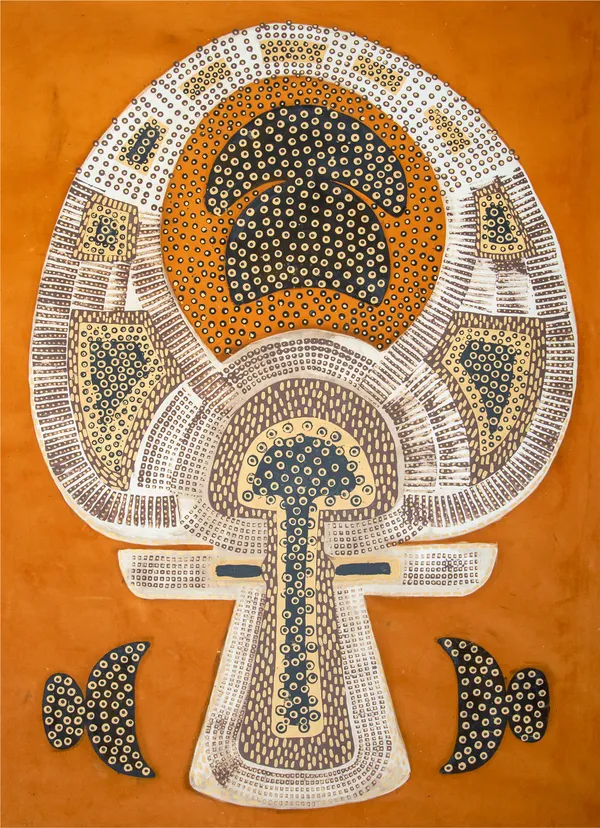
Daniela Ribeiro Angola, b. 1972

The Portuguese-Angolan visual artist Daniela Ribeiro develops a visual language situated within what she terms scientific surrealism. More than an aesthetic proposition, it constitutes a conceptual investigation that articulates the most disruptive technological advances of contemporary society with ancestral African cosmologies.
At the core of her practice lies an essential question: in what ways can emerging technologies — biotechnology, bionics, artificial intelligence, quantum physics — enter into dialogue with millennia-old knowledge systems and African epistemological traditions? In addressing themes such as transhumanism, Ribeiro moves beyond futuristic speculation to examine the ethical, philosophical, and cultural implications of these transformations. Her dual cultural heritage functions not merely as an identity framework but as a critical apparatus that guides and deepens her visual thinking.
Within her compositions, ancestral symbols, ritual markings, and cosmogonic references coexist with algorithms, bionic prostheses, molecular structures, and quantum visualisations. This convergence is not merely formal; it constitutes an epistemological gesture that challenges hierarchies of knowledge. By bringing these realms into proximity, the artist proposes that the holistic understanding of interconnectedness among all beings — central to many African traditions — offers essential tools for navigating the ethical dilemmas of the technological present.
In the field of artificial intelligence, she interrogates not only the expansion of computational capacities but the very nature of consciousness and subjectivity, invoking African notions of interdependence and community. In exploring resonances with quantum physics, she highlights parallels between scientific non-linearity and cosmological visions that conceive time and existence as dynamic networks of energy, memory, and relation.
Daniela Ribeiro’s work thus emerges as a singular contribution to contemporary debates on technology and humanity. Her scientific surrealism unfolds as a critical and decolonial practice of the technological imaginary, vital at a historical moment in which humanity is redefining its limits and urgently reassessing what it means to remain human.